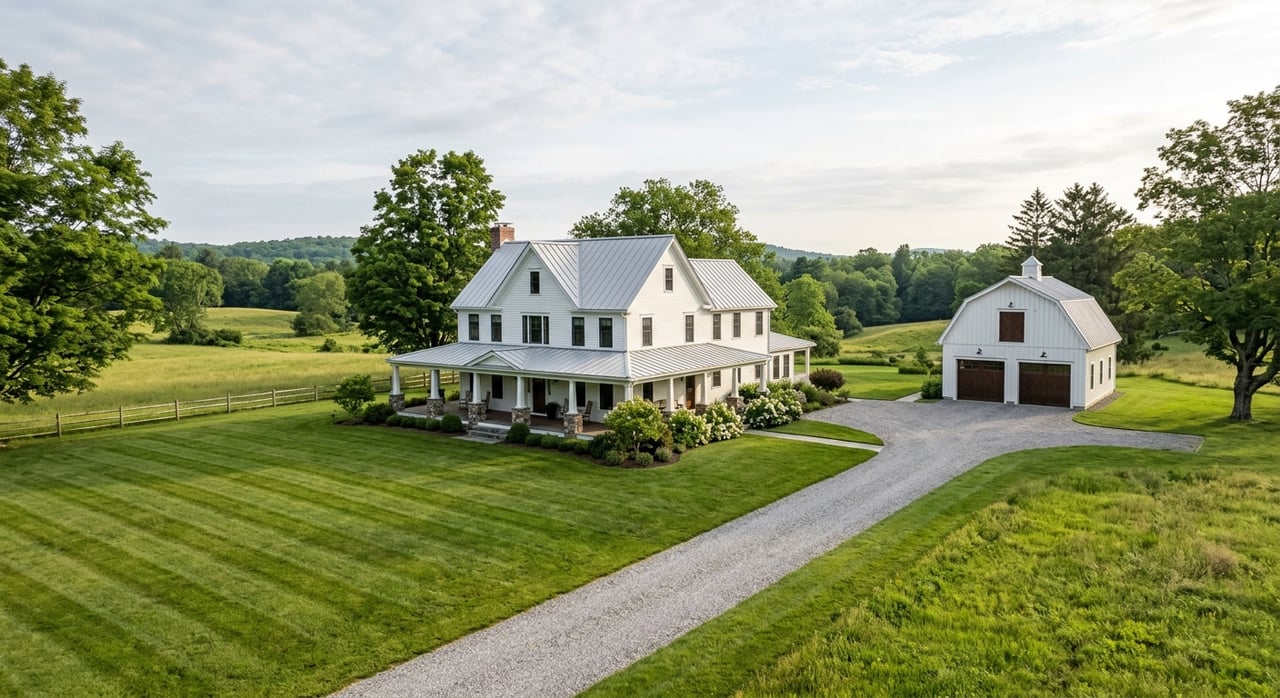
Buying Acreage Or A Mini-Farm In Augusta County
May 14, 2026
May 14, 2026
Dreaming about a few open acres, a garden, a barn, or maybe even a small herd? Buying acreage or a mini-farm in Augusta County can be incredibly rewarding, but rural property comes with a different set of questions than a typical home purchase. If you want to avoid expensive surprises, you need to look closely at zoning, access, utilities, and land-use rules before you close. Let’s dive in.
Acreage can look simple at first glance. You may see a house, a field, a driveway, and plenty of room to spread out.
But in Augusta County, what you can actually do with a property depends on more than appearances. Zoning rules, access requirements, septic capacity, well permitting, and tax-status questions can all shape whether a parcel truly fits your goals.
If you are buying for a lifestyle move, a hobby farm, or future land use, it helps to slow down and verify the details early. That patient approach can save you time, money, and frustration later.
Zoning is one of the first things to confirm when you are considering acreage or a mini-farm. Augusta County’s Zoning Office interprets and enforces the ordinance, and it also handles items like special use permits, variances, and home occupation permits.
Several rural zoning districts matter most to acreage buyers in Augusta County. The most common ones to understand are General Agriculture (GA), Rural Residential (RR), and Rural Conservation (RC).
GA, or General Agriculture, is intended to support agricultural use, conserve farmland and forestland, and reduce pressure for public sewer and water. In this district, agricultural and agriculture-related uses are allowed, along with one single-family dwelling.
For many buyers, GA can be appealing because it is built around rural land use. That said, if you are thinking about activities like agritourism, farm events, or other accessory uses, you should verify the details early because some uses may require a special use permit if district standards are not met.
RR, or Rural Residential, is intended for low-density residential development mixed with agricultural land. It allows one single-family dwelling, and limited agriculture is allowed on parcels of at least 5 acres.
The district also has dimensional standards that matter. RR requires a 2-acre minimum lot area and 40 feet of frontage on a public street, so a property that looks workable online may still need closer review before you assume it fits your plans.
RC, or Rural Conservation, works differently from the other rural districts. It is designed to preserve rural landscape, farmland, and open space in low-density open-space developments.
This district requires at least 200 contiguous acres, a 2-acre minimum lot area, and at least 70% of the gross acreage in permanently preserved tracts. If a property is part of an RC development, that conservation structure can affect how the land is used and what changes are possible.
A mini-farm means different things to different buyers. For one person, it may mean a few chickens and a garden. For another, it may mean pasture, equipment storage, or a future outbuilding.
That is why your intended use should drive your due diligence. If you want chickens, agriculture-related structures, farm events, or another accessory use, Augusta County’s rules should be checked before you move forward, not after closing.
In some cases, the answer may be straightforward. In others, the use may need additional county review or a permit path, so it is smart to ask specific questions tied to your actual plans.
Zoning is only part of the picture. Augusta County also has an Agricultural/Forestal District program and a separate land-use assessment program, and buyers often confuse the two.
The Agricultural/Forestal District program is voluntary and protects farm, timber, and open-space land for 4 to 10 years. The county currently lists four districts.
The land-use assessment program is different. For agricultural qualification, the county generally requires 5 acres in qualifying production for sale. For forestal use, it requires 20 acres. The program also requires annual income of $1,000 or more, annual revalidation, and a change in use can trigger rollback tax.
If you hope to farm the property or benefit from land-use taxation, verify whether the parcel already qualifies or could qualify before closing. Timing matters too, since Augusta County says new land-use applications are due by November 1 and revalidations run from October 1 through December 5 each year.
One of the biggest rural-property mistakes is assuming that a visible driveway means the access is settled. In Augusta County, access can be just as important as the acreage itself.
For new dwellings, the county’s building-permit checklist requires a highway entrance permit. The county also says written VDOT approval is expected even if the driveway already exists or the access is on a private drive.
That means you should confirm the entrance-permit path early. It is also wise to verify whether any shared private road has recorded maintenance rights or subdivision approval before you waive contingencies.
Access questions often show up in plats and subdivision records. In RR subdivisions created after February 28, 2010, lots must access a subdivision street or an internal road system.
County subdivision rules also require minor plats to show exact dimensions, existing and proposed private streets and easements, surveyor or professional engineer identification, and a high degree of survey accuracy. For lots under 20 acres, the plat must also include written confirmation that sewer or onsite sewage can be approved, and lots without required frontage need confirmation that VDOT entrance rules can be met.
VDOT governs work in the right of way, including private entrances. VDOT defines a private entrance as one serving up to two private residences or access for agricultural field use.
Its guidance recommends a minimum driveway width of 12 feet and driveway grades no steeper than 10 percent. Those practical standards can matter a lot when you are evaluating a steep or narrow homesite.
Many acreage buyers focus first on views, fields, and fencing. Those are important, but utility feasibility can make or break a rural purchase.
Augusta Water says it serves roughly 55% of county residents. Even so, rural parcels should always be checked individually because many properties will still rely on private well and septic rather than public water and sewer.
If a parcel is not served by public utilities, Augusta County’s permit process requires septic and or well permits. Existing septic systems also require Health Department approval through the Safe, Adequate & Proper process, and final occupancy requires an approved sewage and water operation permit from the Health Department.
If you plan to add bedrooms to a home on septic, county rules also require Health Department approval. That is a key detail for buyers who are thinking ahead to renovations or expansion.
The Central Shenandoah Health District serves Augusta County and issues sewage disposal system and private well permits. It also handles records searches and maintains provider resources for existing well and septic information.
Since August 11, 2019, applications for onsite sewage systems and private wells must be supported by work from a properly licensed private-sector consultant in most cases. For buyers, that means septic and well feasibility usually needs to be part of your normal due diligence, not a last-minute item.
When you look at a mini-farm property, the question is not only whether water exists nearby. The bigger question is whether the intended use can be supported by a permitted well and a septic system with enough capacity for the home and your plans.
That is especially important if you are evaluating a future homesite, considering more bedrooms, or planning improvements that may affect system demand. Rural property works best when the land and infrastructure match your real goals.
Online parcel maps are helpful for getting oriented, but they are not a legal description. Augusta County specifically notes that GIS parcel lines are approximate only.
The county may require a survey after reviewing a sketch plan, and subdivision plats require a licensed land surveyor or professional engineer, exact layout information, and building locations near any new lot line. If boundaries, road frontage, or lot history are unclear, a survey or plat review is often worth doing before you close.
For acreage buyers, this is a major point. Fence lines, old farm lanes, and even existing use patterns do not always match the legal boundary.
When you buy acreage or a mini-farm, the order of your due diligence matters. A clear sequence helps you avoid spending money in the wrong places or overlooking a major issue.
Here is a practical approach based on Augusta County’s local rules and processes:
This kind of process is especially helpful if you are buying from out of town. Having a patient, local advisor who understands acreage transactions can make the path much smoother.
The right Augusta County property can offer space, privacy, flexibility, and a lifestyle that is hard to replicate in a typical neighborhood setting. But rural real estate rewards buyers who ask careful questions early.
If you are considering acreage, a mini-farm, or land with future potential, the goal is not just finding a beautiful parcel. The goal is finding one that truly supports how you want to live and use the property.
That is where local, boots-on-the-ground guidance matters. If you want a patient, strategy-first approach to buying acreage in Central Virginia, Gavin Sherwood can help you evaluate the details with clarity and confidence.


Contact Gavin today to learn more about his unique approach to real estate and how he can help you get the results you deserve.

969 2nd St SE Charlottesville VA 22902